

FG Moves To Harmonise 2026, 2027 Budgets Into Single Spending Plan
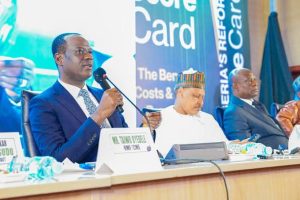 The Federal Government is planning to harmonise the 2026 and 2027 budgets into a single national spending plan by carrying outstanding capital expenditure balances from the current fiscal year into next year’s budget.
The decision was reached at a meeting of the Economic Management Team, EMT, chaired by the Minister of Finance and Coordinating Minister of the Economy, Taiwo Oyedele, in Abuja.
The proposed arrangement is expected to allow the government to implement as much of the 2026 capital budget as possible while transferring outstanding balances into 2027, in a move aimed at aligning public spending with more realistic revenue and financing expectations.
The EMT said it had advanced work on harmonising the budgets around more realistic revenue and financing assumptions, while working towards a single annual budget cycle going forward.
The meeting was attended by Ministers of Marine and Blue Economy, Adegboyega Oyetola; Power, Joseph Tegbe; Communications, Innovation and Digital Economy, Bosun Tijani; Regional Development, Abubakar Momoh; Labour and Employment, Muhammadu Maigari Dingyadi; and Art, Culture, Tourism and Creative Economy, Hannatu Musa Musawa.
Others present included the Minister of State for Petroleum Resources (Gas), Ekperikpe Ekpo; Minister of State for Budget, Doris Uzoka-Anite; Deputy Governor, Economic Policy, Central Bank of Nigeria, Philip Ikeazor; Special Adviser to the President, Tope Fasua; Permanent Secretaries of the Ministries of Finance and Transportation; and Postmaster General, Omotola Odeyemi, among other senior government officials.
The meeting also reviewed progress on the 2027 Finance Bill, which is expected to update Nigeria’s tax laws and introduce further improvements to the ongoing tax reform programme.
The proposed legislation is part of the government’s broader strategy to improve the ease of doing business, reduce borrowing costs and increase the availability of funds within the financial system for businesses and other productive sectors.
According to the EMT, the proposed tax changes are intended to support economic activities by improving the business environment and encouraging the flow of financial-sector liquidity into the real economy.
The team also reviewed measures to improve food security and stabilise the prices of essential food items, including cassava, yam, maize and rice.
The food stability programme is being pursued under a 90-day action plan earlier approved by the National Economic Council and endorsed by the Federal Executive Council.
As part of the intervention, the government plans to strengthen the delivery of farm inputs to farmers, reduce post-harvest losses and improve the targeting of agricultural support to ensure that assistance reaches intended beneficiaries.
The measures are expected to address challenges affecting food availability and the prices of major staples, amid efforts to sustain the decline in inflation and improve household welfare.
The EMT also considered plans to strengthen the power sector through improved coordination of gas supply and electricity distribution.
It reviewed Nigeria’s national gas plan and the power sector’s 90-day action plan, which targets consistent electricity distribution of about 5,500 megawatts in the near term.
The plan also includes measures to improve electricity transmission capacity, expand metering and protect critical power infrastructure against vandalism and theft.
On the state of the economy, the EMT reported that Nigeria recorded real Gross Domestic Product growth of 4.43 per cent in the second quarter of 2026.
Headline inflation declined to 14.06 per cent in October, its lowest level in six years, while core inflation also continued to ease.
The country’s external reserves stood at about $55bn, while the exchange rate was reported to be stable and appreciating.
The team reviewed the indicators as part of its assessment of the country’s macroeconomic performance and efforts to sustain economic stability.
Nigeria’s improving credit rating outlook also featured in the discussions, with the EMT noting that Moody’s and Fitch revised the country’s sovereign credit outlook from stable to positive in 2026.
This followed an earlier decision by S&P Global in May 2026 to upgrade Nigeria’s sovereign credit rating from B- to B.
The EMT described the three rating developments as important assessments of Nigeria’s creditworthiness and economic outlook by international rating agencies, while stressing the need for discussions about the economy and the country’s credit ratings to be based on data and verifiable evidence.
To improve access to official economic information, the Ministry of Finance is working towards publishing finalised financial and economic information on its website before the end of the year.
The move is expected to provide a more accessible source of government economic and financial information for investors, businesses and other interested parties.
The EMT also reviewed the draft National Development Plan covering 2026 to 2036, designed around seven major areas of economic and national development.
The proposed 10-year plan covers macroeconomic stability, energy, industrialisation, infrastructure, governance, security and human capital development.
Members of the team were asked to undertake further reviews of the document, with their observations and recommendations expected to be incorporated before its eventual launch.
The plan is expected to provide a broad framework for coordinating Nigeria’s economic and development priorities over the next decade.
In another development, the team received updates on the creative economy and tourism sectors, including progress on a creative economy bill currently before the National Assembly.
It also discussed plans for a Presidential Council on Tourism, which has received approval from the Federal Executive Council.
The proposed council is part of the government’s efforts to strengthen coordination in the tourism sector and advance activities within the creative economy.
The meeting also received a presentation on Nigeria’s new national digital addressing system, although details of its implementation arrangements and expected coverage were not provided.
The development was considered alongside other government initiatives aimed at improving coordination across different sectors of the economy.