

Tinubu Pledges 28,000 More Military Personnel, 50,000 Police Officers In 2027 Manifesto
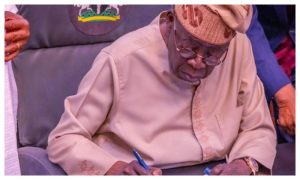 President Bola Tinubu has pledged to recruit an additional 28,000 military personnel and 50,000 police officers if re-elected in 2027, as part of plans to strengthen Nigeria’s security architecture and tackle terrorism, banditry and kidnapping.
The promises are contained in the All Progressives Congress 2027–2031 presidential manifesto, titled From Reform to Prosperity Agenda 2027–2031, a 109-page document ahead of its official unveiling on Tuesday, November 10, at the Shehu Musa Yar’Adua Centre in Abuja.
Beyond security, the manifesto outlines targets of six per cent annual economic growth, the construction of 200,000 affordable homes, improved electricity supply and sustained reductions in inflation and food prices by 2031.
Tinubu said his second term would focus on translating the economic reforms and foundations laid during his first tenure into tangible improvements in the lives of Nigerians, with prosperity extending to homes, markets, farms and workplaces.
Under the security plan, the President pledged to strengthen the Armed Forces and other security agencies through improved recruitment, specialised training, modern equipment, intelligence gathering and better welfare for personnel.
The manifesto proposes completing and equipping four new Army divisions in Makurdi, Ilorin, Jalingo and Benin City, alongside recruiting and training the additional 28,000 military personnel already approved.
It also promises sustained intelligence-led military operations against insurgent and kidnapping networks, specialised zonal counter-terrorism capabilities and improved security around schools, markets, places of worship and major transport routes.
On policing, Tinubu plans to train and deploy 50,000 newly recruited officers and expand recruitment and tactical training towards a police-to-citizen ratio of one officer to 400 Nigerians.
The proposed reforms include digital police records, body cameras, geographic mapping tools, modern forensic facilities and improved emergency response systems.
The manifesto also proposes recruiting 30,150 personnel into the Nigeria Security and Civil Defence Corps to take over static security duties from the police. It further promises to work with lawmakers and state governors to establish a legal framework for accountable state and community policing.
Other security measures include completing electronic surveillance coverage of mapped national borders, expanding passenger-data systems and strengthening patrols, screening and intelligence-sharing.
The government also plans to extend Mining Marshals operations to all identified mining sites, deploy Forest Guards and Agro-Rangers to protect farming communities and forest reserves, and strengthen surveillance of critical national assets such as electricity grids, pipelines, railways, schools and health facilities.
Tinubu further pledged to expand domestic production of ammunition, armoured vehicles, personal protective equipment and tactical drones through technology partnerships.
The manifesto promises improved salaries, housing and working conditions for security personnel, alongside faster payment of insurance and pensions to families of fallen officers.
On the economy, the APC manifesto targets annual growth of six per cent by 2031, a reduction in youth unemployment by half and expanded access to equitable credit for half of all economically active Nigerians.
It also proposes facilitating the construction of 200,000 affordable homes for Nigerian workers through the Tinubu Mass Social Housing Scheme, mortgage financing and partnerships with licensed private developers.
The President said the housing initiative would improve access to decent accommodation for working households while strengthening regulations to protect property buyers.
In the power sector, the administration plans to scale available electricity generation towards 10,000 megawatts, extend metering towards full coverage and reinforce transmission and distribution networks.
It also seeks to expand clean energy access to underserved communities.
On education, Tinubu pledged to recruit and train 20,000 additional teachers, building on the 80,284 teachers already certified and licensed.
The manifesto also promises to halve the number of out-of-school children, strengthen foundational learning and expand science, technology, engineering, mathematics and digital education.
Other proposals include enforcing safe-school standards, improving water and sanitation facilities, expanding technical and vocational training and scaling the Nigerian Education Loan Fund (NELFUND) and other student support initiatives.
The government also plans to expand the Mandatory School Sports Programme and the National Sports and Education Excellence Programme, building on a pilot involving 61 schools, 3,500 teachers and 15 trained students.
In healthcare, Tinubu targets increasing the proportion of functional primary healthcare centres nationwide from the current 53 per cent to 90 per cent by 2031.
The manifesto also proposes expanding active health insurance coverage from more than 23 million enrollees to 40 per cent of Nigerians, while reducing out-of-pocket spending from 71 per cent to below 50 per cent of total health expenditure.
The administration further promises to extend direct quarterly financing under the Basic Health Care Provision Fund to all 17,600 primary healthcare centres, up from about 8,300 currently.
Other healthcare commitments include completing the revitalisation of about 1,000 remaining primary healthcare centres, expanding free emergency obstetric care to all 774 local government areas and providing steady power to 30 per cent of health facilities by the end of 2027 through solar installations.
Tinubu also pledged to improve the recruitment, training and welfare of healthcare workers, increase local production of essential medicines to 50 per cent by 2031 through BioVaccines Nigeria and complete cancer treatment centres across the six geopolitical zones.
The manifesto further outlines plans to modernise fire stations, strengthen maritime surveillance and cybersecurity, deploy drones for emergency response and enrol 95 per cent of Nigerians in the National Identity Database.
On governance, the President promised to extend digital case management systems to magistrate courts, improve public service delivery monitoring and ensure local governments receive their constitutional allocations under clear performance standards.
The APC leadership is scheduled to formally unveil the manifesto at 11am on Tuesday in Abuja, setting out the party’s proposed priorities and targets for the 2027–2031 period.