

Putin Vows To Help End Middle East War In Talks With Iran’s Pezeshkian
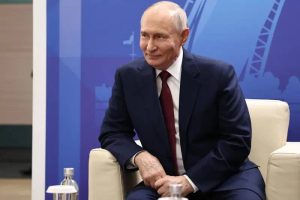 Russian President Vladimir Putin has pledged to do everything within his power to help end the Middle East war during talks with Iranian President Masoud Pezeshkian in Turkmenistan.
The meeting, reported by Russian media on Thursday, took place ahead of a summit of the Commonwealth of Independent States (CIS), scheduled to begin on Friday in the Caspian Sea resort of Avaza.
“We are ready to do everything that is in our power to contribute to the settlement of this situation,” Putin said.
He added that Iran had made “real efforts to end the war” since US-Israeli attacks began on February 28, according to Russian news agencies.
Putin also pointed to what he described as the “positive evolution” of relations between Moscow and Tehran.
The two countries have strengthened their diplomatic and military cooperation since Russia launched its offensive in Ukraine in February 2022, with both increasingly relying on each other amid Western sanctions.
Ukraine and Western countries have accused Iran of supplying Russia with Shahed drones and short-range missiles used in attacks on Ukraine.
Russia, meanwhile, has been accused of providing Iran with intelligence data to support attacks on US targets in the Middle East.
Putin and Pezeshkian also met on the sidelines of the Shanghai Cooperation Organisation summit in Kyrgyzstan last month. During a telephone conversation on Wednesday, Putin reportedly told the Iranian leader that Moscow was ready to help mediate the Middle East conflict, according to Iran’s state news agency, IRNA.
Iran-US Talks At An Impasse
The latest diplomatic engagement comes amid stalled negotiations between Iran and the United States, with Pezeshkian describing talks with Washington as “meaningless” earlier in the week.
Speaking during his meeting with Putin, Pezeshkian accused the United States of repeatedly undermining diplomatic efforts through military action.
“We are engaged in dialogue, but every time we negotiate with the United States, they attack again,” Iranian state media quoted him as saying.
The Iranian president said Tehran wanted a “final framework” to end the war but warned that an agreement would remain elusive if Washington continued to impose its position on other countries.
“If the United States insists on pursuing a unilateral approach, a resolution will not be possible,” he said.
US President Donald Trump, meanwhile, ruled out another attack on Iran before the US midterm elections scheduled for November 3, saying on Thursday that Washington was holding “productive discussions” with the Islamic Republic.
Diplomatic efforts to resolve Russia’s war in Ukraine also appear deadlocked, even as Moscow and Kyiv intensify their attacks.
Putin Seeks To Strengthen Regional Ties
Putin and Pezeshkian are expected to attend the CIS summit alongside leaders from Armenia, Azerbaijan, Belarus, Turkmenistan and other Central Asian countries.
Kremlin foreign policy aide Yuri Ushakov said the meeting between the Russian and Iranian presidents was among several bilateral engagements planned on the sidelines of the summit.
Established in 1991 following the collapse of the Soviet Union, the CIS was created to maintain cooperation and ties among former Soviet republics.
However, several countries have since withdrawn or reduced their participation. Georgia left the grouping following its 2008 war with Russia, Ukraine halted its participation after Moscow’s 2014 annexation of Crimea, and Moldova withdrew in 2023 as it pursued closer ties with the European Union.
For Russia, which has faced growing international isolation since launching its full-scale offensive in Ukraine in 2022, the CIS remains a platform for demonstrating its regional influence.
Temur Umarov, a researcher at the Carnegie Russia Eurasia Center in Berlin, told AFP that the grouping demonstrated that Russia still had an established sphere of influence.
However, analysts say the summit also comes as several CIS members seek to diversify their economic and diplomatic relationships by strengthening ties with China and Western countries.
Zhanibek Arynov, a Kazakhstan-based researcher specialising in Central Asian geopolitics, cautioned that Russia could not automatically count on the support of other members.
“Even if Russia decides to use this platform to propagate anti-Western or anti-Ukrainian rhetoric, that does not mean the other members will automatically subscribe to its position,” Arynov said.
The summit is expected to provide a platform for regional leaders to discuss cooperation at a time of heightened geopolitical tensions and shifting international alliances.