

Tinubu, Obi, Sowore, others sign peace accord as 2027 campaigns begin
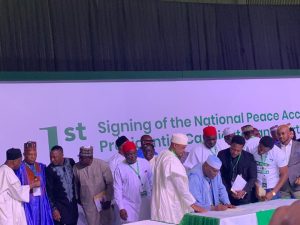 President Bola Tinubu, Peter Obi, Omoyele Sowore and other presidential candidates and political stakeholders have signed the first National Peace Accord on issue-based campaigns ahead of the 2027 general elections.
The accord was signed in Abuja on Tuesday at a ceremony organised by the National Peace Committee in partnership with The Kukah Centre, ahead of the statutory commencement of campaigns and rallies for the elections today, August 19.
The political actors pledged to shun violence, hate speech, misinformation, personal attacks and other actions capable of undermining the electoral process.
President Tinubu, represented by the Secretary to the Government of the Federation, George Akume, urged political parties and candidates to place national interest above personal and partisan ambitions.
He cautioned politicians against exploiting ethnic and religious sentiments, calling for campaigns centred on policies, programmes and solutions to Nigeria’s challenges.
> “Let us campaign on superior ideas. Let us debate issues and promote the best policies to expand opportunities for our people,” Tinubu said.
The President also pledged the commitment of the All Progressives Congress to the accord, saying the party rejected violence, hate speech, misinformation, incitement and digital manipulation.
The Chairman of the Independent National Electoral Commission, Professor Joash Amupitan, described the accord as an opportunity for political actors to establish the ethical boundaries of the 2027 contest before campaigns officially begin.
Amupitan said the commission had observed an “alarming resurgence” of hate speech, toxic polarisation, coordinated misinformation and personality-driven political discourse.
He urged candidates to focus their campaigns on issues including the economy, insecurity, healthcare, education, infrastructure and social inclusion.
> “Electoral contests in a constitutional democracy are not total wars; they are competitive job interviews before the electorate. Nigerians do not want insults; they want solutions,” he said.
The INEC chairman also warned political parties against premature victory declarations and the circulation of unverified information, particularly through social media and artificial intelligence platforms.
He disclosed that INEC was preparing to deploy about 1.4 million ad hoc personnel across more than 176,000 polling units for the 2027 elections.
However, he stressed that technological and administrative preparations alone could not guarantee peaceful elections.
> “We provide the pitch and the refereeing, but the quality of the game depends on the players,” Amupitan said.
Former Vice-President Peter Obi, who also signed the accord, questioned the need for political leaders to be reminded to behave responsibly.
He said candidates seeking public office should demonstrate the qualities expected of the offices they aspire to occupy.
> “You can’t answer ‘His Excellency’ without being an excellent person,” Obi said.
Obi also called for accountability over deaths recorded during the recent Osun governorship election, urging political actors to remember victims and ensure that nobody dies because of an election.
He said his major concern ahead of 2027 was the credibility of the electoral process.
> “For the sake of the children of Nigeria, can we have an election where people’s votes will count?” Obi asked.
However, the presidential candidate of the African Action Congress, Omoyele Sowore, dismissed the peace accord as largely symbolic, arguing that previous agreements had failed to prevent electoral violence.
Sowore cited alleged deaths during the recent Osun election and questioned why an election associated with fatalities could be described as peaceful.
He also criticised INEC over the delayed uploading of results from the Osun poll, arguing that results should be transmitted and made available promptly.
Sowore called for a “justice accord” with enforceable sanctions against political actors who violate the peace agreement.
The Chairman of the National Peace Committee, former Head of State General Abdulsalami Abubakar, represented by former Chief of Defence Staff General Martin Agwai, said the committee had facilitated 30 peace accords since 2015.
He said the latest agreement was designed to encourage political parties and candidates to compete on ideas, respect electoral institutions, organise supporters peacefully and reject hate speech and misinformation.
The Inspector-General of Police, Tunji Disu, represented by the Deputy Inspector-General of Police in charge of Operations, Umar Shehu, also pledged adequate security for voters, candidates and other participants.
He said the police would remain neutral and were primarily concerned with ensuring that Nigerians could exercise their franchise without intimidation.
> “The Nigeria Police is not interested in who wins or loses but is interested and committed to a peaceful election where Nigerians of eligible age will exercise their franchise without fear,” Shehu said.
The 2027 presidential and National Assembly elections are scheduled for January 16, 2027, while governorship and State House of Assembly elections are scheduled for February 6, 2027.
With campaigns beginning today, the peace accord places the conduct of political actors under renewed scrutiny, particularly whether the commitments made in Abuja will translate into peaceful, issue-based campaigns across the country.