

Osun 2026: Adeleke defends record as Oyebamiji, Salaam unveil plans
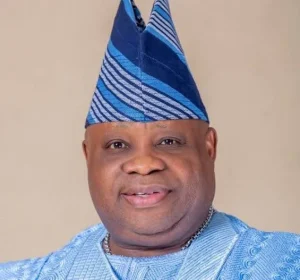 The three leading candidates in Saturday’s Osun State governorship election on Tuesday made their final pitches to voters, with the incumbent governor and Accord candidate, Ademola Adeleke, defending his administration’s record, while his All Progressives Congress counterpart, Bola Oyebamiji, and African Democratic Congress candidate, Najeem Salaam, unveiled their plans for the state.
The candidates spoke during a town hall meeting organised by Arise Television, where they highlighted their achievements, policy priorities and strategies for addressing Osun’s economic, security and development challenges.
Adeleke, who is seeking a second term, highlighted his administration’s road construction, healthcare and infrastructure projects.
Oyebamiji promised to prioritise welfare, security, agriculture, education and healthcare, while Salaam placed agriculture and community policing at the centre of his campaign agenda.
Defending his administration’s performance, Adeleke said his government had constructed about 350 kilometres of roads across the state, adding that it had also undertaken the rehabilitation of some federal roads without receiving payment from the Federal Government.
“If you come to Osun, you’ll see that I’ve constructed 350km of roads that cut across the state. As for federal roads, I have handled about eight or nine of them, and I haven’t been paid.
“As I’m speaking to you, I not only build roads across Osun, I also installed solar lights on them. We did this to provide security and enhance economic development.
“As of today, we have upgraded and rehabilitated over 200 primary healthcare facilities to global standards, equipped with electricity and clean water,” he said.
The governor dismissed allegations that his administration had concentrated development in his hometown, Ede, describing the claims as false.
He said, “Reports of Edenisation in our administration are false. Yesterday, I just commissioned a flyover in Ile-Ife, and I am not from Ile-Ife.
“I have commissioned dualised roads in Ila Orangun, Iwo, Osogbo, Ilesa, etc., all built by our administration. Should I abandon Ede because it is my town?”
Adeleke also dismissed criticism of his dancing at public events, saying it had no bearing on his performance in office.
“Those who can’t dance are jealous of me. In my family, we have music in our blood. Nobody will stop me from dancing. I dance and work. There is time to dance, and there is time to work.
“I dance because in my family, we are jolly good fellows. As I am dancing, I am working. There is time for everything; there is time to dance, and there is time to work. Dancing does not stop me from working. I have delivered across all sectors,” he said.
Oyebamiji said he was prepared for governance, having visited all the local government areas in the state more than once to consult members of his party and other stakeholders.
The former Managing Director of the National Inland Waterways Authority said his administration would prioritise the welfare and security of residents while investing in agriculture, education and healthcare.
“My journey and my destiny, which I have a pact with, took me to Osun as the incoming governor of Osun State. Governance is about people and not about segments; it’s not about an area, a city; it’s the entire people of Osun that I want to serve.
“You have seen that the welfare of our people in Osun is very paramount; security is very important; these are the things that I want to bring up, and we want to banish hunger and poverty, and I want to invest seriously in agriculture, education and health.
“Apart from that, our human asset is very important to us. We are going to look at their welfare; capital development is very important, and these are the things that I’m bringing on board,” he said.
On the proposed establishment of state police, Oyebamiji described the policy as welcome but stressed the need to follow due process.
“Well, state police, I think, is a good policy. It is a welcome policy, but one thing that is important is that there is a process, and that if that process is followed, in governance, it is always about the institution. It is about process, it is about rules, it is about regulations,” he said.
Oyebamiji also defended his record as Commissioner for Finance under former Governor Adegboyega Oyetola, claiming that the administration did not take loans and left N15bn in the state’s coffers when it left office.
On his part, the ADC candidate, Salaam, said his administration would establish farmers’ markets and farm estates across the state if elected.
He described agriculture as one of the sectors capable of reviving Osun’s economy if given adequate government support.
“I am a farmer, and I practise farming. Farming is about timing and season. It is only farming that can revive the economy if it gets government support,” he said.
Salaam promised to provide farmers with equipment and other support to increase production and ensure food availability.
He said his campaign agenda included providing two tractors for each local government area in the state.
“I am going to establish farmers’ markets where farmers can sell their food directly to people without intermediaries. This will boost supply and, by doing so, improve the economy,” he said.
On security, Salaam said his administration would prioritise community policing alongside the implementation of the state police structure.
“Aside from state police that is already at the stage of implementation, one of the areas my government will focus on is community policing.
“I am going to involve traditional rulers because they are the ones who know their community and people better,” he said.
Salaam also pledged to empower local hunters, vigilantes and other community-based security groups to complement conventional security agencies.
He said Baales, chiefs and other community leaders would be involved in securing their communities and identifying criminal elements.
According to him, the approach would help communities identify criminal elements, prevent criminals from using Osun as a safe haven and reduce the impact of insecurity spilling over from neighbouring states.