

FG unveils net-zero investment plan, targets carbon neutrality by 2060
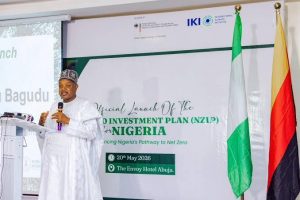
The Federal Government on Wednesday launched its Net-Zero Investment Plan, outlining Nigeria’s pathway to achieving carbon neutrality by 2060 and accelerating clean investment-driven economic growth.
The plan was unveiled in Abuja by the Minister of Budget and Economic Planning, Senator Abubakar Atiku Bagudu, during an event attended by senior government officials, development partners and private sector stakeholders.
Bagudu said the initiative aligns climate action with Nigeria’s long-term economic strategy and aims to reduce greenhouse gas emissions while attracting climate-focused investments.
“We are here to emphasise that Nigeria is not reluctant to commit to initiatives that may affect the private sector, which seeks financing for various projects,” the minister said.
He disclosed that recent engagements with German partners secured commitments for climate financing, including €71 million in contributions and a €300 million credit guarantee to support climate-related investments.
Bagudu linked the policy direction to constitutional provisions on environmental protection and national development.
“Nigeria’s Agenda 2050 recognises that environmental management and sustainability are integral to national planning, not tangential,” he said.
The minister added that environmental lessons from areas affected by degradation, including Ogoniland, have influenced current policy priorities, with stronger regulation, improved technology and data-driven approaches guiding environmental management.
Speaking at the event, Head of International Cooperation at the German Embassy, Dr Karin Jansen, described the investment plan as a Nigerian-led initiative developed through consultations involving government institutions, experts, businesses and civil society groups.
“This investment plan is, above all, a Nigerian initiative, and Germany is proud to support it through funding and technical cooperation under the International Climate Initiative,” Jansen said.
She noted that implementation would focus on converting policy frameworks into viable projects capable of delivering measurable economic and environmental outcomes.
The Net-Zero Investment Plan targets major sectors including power, transport, agriculture, industry and waste management.
It also seeks to strengthen support for women, young people and small businesses as part of efforts to build a climate-resilient and low-carbon economy.