

PFIPC scandal: Senate to address ₦1.3bn budget controversy as new details emerge
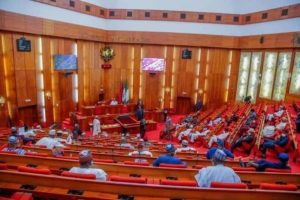 The Senate is expected to address the controversy surrounding the ₦1.3 billion allocation to the alleged Presidential Foreign Intervention Promotion Council (PFIPC) in the 2026 Appropriation Act when plenary resumes on Tuesday.
The development comes amid fresh revelations that a forged appointment letter, purportedly signed by the Chief of Staff to the President, Femi Gbajabiamila, was allegedly used to secure office accommodation for Prince Adeniyi Adeyemi Mathew at the Federal Secretariat in Abuja, giving the controversial agency the appearance of legitimacy for more than a year.
According to multiple Presidency and civil service sources, the alleged fraud succeeded because of failures in due diligence across several government institutions, including the Budget Office, the House of Representatives and the Office of the Head of the Civil Service of the Federation.
The sources maintained that the forged letter enabled the purported council to interact with government ministries, diplomatic missions, the National Assembly and private organisations before the scheme was uncovered.
They also disclosed that the ₦1.3 billion allocation was approved without Adeyemi or any official of the council appearing before the Senate Committee on Establishment and Public Service to defend the proposed budget.
A National Assembly source alleged that the allocation was introduced through a “backdoor” process.
“It was not brought in as a stand-alone item. It was done collectively with others that came in directly from the Presidency. So there was no defence or oversight,” the source said, adding that the Senate leadership was expected to address the controversy to clarify issues surrounding the appropriation.
Presidency sources explained that, under Nigeria’s constitutional procedure, appointments to agencies under the Presidency are made by the President and formal appointment letters are issued by the Secretary to the Government of the Federation (SGF), not the Chief of Staff.
According to one source, Adeyemi allegedly exploited this bureaucratic gap by presenting a forged appointment letter bearing a falsified signature of the Chief of Staff to obtain office space at the Federal Secretariat.
Officials said the office allocation gave the alleged council credibility, enabling it to operate with official letterheads, a website and interactions with both local and foreign institutions before questions were eventually raised.
Another Presidency source said officials of the Nigerian Investment Promotion Commission (NIPC) first detected irregularities after noticing that the purported council was encroaching on the commission’s statutory responsibilities.
The matter was subsequently reported to the Chief of Staff, who allegedly denied any knowledge of Adeyemi and referred the case to the Department of State Services (DSS).
According to the sources, Adeyemi has already been arraigned before the Federal High Court in Abuja on charges bordering on fraud and forgery but is alleged to have violated his bail conditions. He is scheduled to return to court on July 27, 2026, alongside two accomplices said to be at large.
Meanwhile, the controversy has continued to generate reactions from opposition parties, civil society organisations and legal experts.
The Socio-Economic Rights and Accountability Project (SERAP) has asked the Senate President, Godswill Akpabio, and the Speaker of the House of Representatives, Tajudeen Abbas, to release certified documents relating to the approval of the ₦1.3 billion allocation.
SERAP is also seeking details of the committees that considered the allocation, officials who defended it, and whether the provision originated from the executive or was inserted during legislative consideration.
The Human and Environmental Development Agenda (HEDA) called for a public inquiry into the matter, while the Committee for the Defence of Human Rights (CDHR) urged that the allegations be independently investigated.
Former Vice President Atiku Abubakar described the controversy as evidence of a broader governance problem, urging President Bola Tinubu to order an independent investigation and provide answers on how the alleged agency emerged within government processes.
Similarly, the Kwankwasiyya Movement questioned how an agency the Presidency insists does not exist found its way into the national budget, calling for a full investigation into the appropriation process.
However, Deputy House of Representatives Spokesman Philip Agbese urged Nigerians to allow the courts to determine the issues, saying the legal process should be allowed to run its course.
Some senior lawyers also cautioned against drawing conclusions before investigations are completed, stressing that criminal liability must be based on evidence rather than allegations. Others argued that everyone who played a role in facilitating the alleged scheme should be investigated.