

Insecurity: Ex-envoy, SANs, others demand urgent restructuring of Nigeria
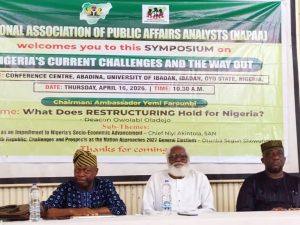 A former Nigerian Ambassador, Yemi Farounbi, alongside legal luminaries and public affairs analysts, on Thursday, renewed calls for the urgent restructuring of Nigeria’s governance architecture, warning that rising insecurity and weakening institutions pose grave threats to the nation’s survival.
Speaking at a symposium organised by the National Association of Public Affairs Analysts at the University of Ibadan Conference Centre, Farounbi described insecurity as the most pressing challenge confronting the country, insisting that only fundamental structural reforms can address the crisis.
According to him, Nigeria’s failure to translate its abundant human and natural resources into meaningful development stems from deep-rooted structural defects, weak institutions, and poor policy implementation.
“Nigeria is not short of ideas or solutions,” he said. “What we lack is discipline, accountability, and an effective structure to implement those solutions. Insecurity today is the clearest sign of systemic failure.”
He stressed that no nation can make progress with a fragile security system and fragmented institutions, urging both leaders and citizens to embrace responsibility in rebuilding governance structures and restoring public trust.
Also speaking, Convener of The Alternative Movement, Segun Showunmi, represented by Lateef Aremu, said Nigeria’s democracy, despite sustaining uninterrupted elections since 1999, remains weak in substance.
Presenting a paper titled ‘Nigeria’s Fourth Republic at a Crossroads: Challenges and Prospects Ahead of the 2027 General Election,’ he noted that elite dominance, weak party structures, economic hardship, and declining voter confidence continue to undermine democratic legitimacy.
He warned that the 2027 general elections would be a defining moment for the country, cautioning that failure to reform key institutions could further erode public confidence in democracy.
In his remarks, Senior Advocate of Nigeria, Niyi Akintola, lamented that persistent insecurity has continued to stifle investment, disrupt agriculture, weaken education, and drain national resources.
He called for stronger legal frameworks and improved institutional capacity to enhance security operations, ensure justice delivery, and enforce accountability.
Earlier, NAPAA Secretary, Jaye Ajayi, emphasised the need for informed civic engagement, noting that the platform was designed to generate practical solutions to Nigeria’s socio-political challenges.
Similarly, the association’s Chairman, Seun Adelore, advocated decentralisation of power, arguing that it would enable regions to harness their resources effectively and drive sustainable development.
The symposium attracted scholars, legal practitioners, political actors, and analysts who examined Nigeria’s governance challenges, insecurity, and democratic future ahead of the 2027 general elections.