

FG Ready to Crush Terrorists, Criminal Networks — Idris
The Federal Government has reaffirmed its readiness to decisively protect Nigerians from terrorists, bandits and other criminal elements, assuring that all security operations are being carried out in line with internationally accepted rules of engagement.
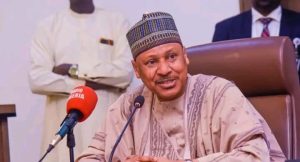
Minister of Information and National Orientation, Mohammed Idris, gave the assurance on Monday in Abuja while briefing journalists at the end-of-year press conference of his ministry.
Idris spoke against the backdrop of public concerns over the Federal Government’s new counterterrorism doctrine, which classifies armed groups operating outside state authority — including bandits, militias, armed gangs and their collaborators — as terrorists.
According to him, Nigeria has both the moral and legal responsibility to defend itself while observing the highest standards of procedure in security operations.
“Nigeria has to defend itself as a sovereign nation by observing the highest standards of engagement,” Idris said.
“Our armed forces are professionally trained, working closely with international partners, and strictly adhering to globally accepted protocols in dealing with terrorists. They deserve commendation for this.”
Reviewing the performance of the President Bola Tinubu-led administration in 2025, the minister said the government remained focused on restoring macroeconomic stability and rebuilding confidence in the economy.
He disclosed that Nigeria’s Gross Domestic Product (GDP) grew by 3.98 per cent in the third quarter of 2025, driven largely by sustained expansion in the non-oil sector.
Idris also noted that headline inflation declined consistently for eight consecutive months, dropping to 14.45 per cent in November 2025, while food inflation followed a steady downward trajectory.
On external indicators, he said Nigeria’s foreign reserves rose to about $44.56 billion, helping to stabilise the naira and improve investor confidence.
The minister further revealed that the country recorded a trade surplus of N6.69 trillion in Q3 2025, representing a 27.29 per cent year-on-year increase.
According to him, investor confidence was further boosted by a massively oversubscribed Eurobond issuance, which attracted subscriptions amounting to 400 per cent of the $2.3 billion target.
Turning to infrastructure, Idris said the administration deliberately tied economic reforms to tangible delivery, stressing that no economy can grow faster than the infrastructure supporting it.
He disclosed that Nigeria achieved a record maximum daily energy output of 128,370.75 megawatt-hours on March 4, 2025, the highest in the nation’s history.
He added that the Federal Government rolled out the Presidential Metering Initiative and issued the first bond under the Presidential Power Sector Debt Reduction Programme.
On road infrastructure, Idris said the government committed over N1.5 trillion in 2025, describing it as the largest single-year investment in road construction in Nigeria’s history.
The investment, he explained, is anchored on four major legacy projects:
the Lagos-Calabar Coastal Highway, Sokoto–Badagry Superhighway, Trans-Saharan Highway, and the Akwanga–Jos–Bauchi–Gombe Expressway.
“These are not conventional roads,” he said.
“They are reinforced concrete highways designed to last between 50 and 100 years, reducing maintenance costs and promoting local content.”
Idris also said reforms extended to agriculture, with President Tinubu approving the recapitalisation of the Bank of Agriculture with N1.5 trillion to boost food security and agribusiness financing.
On security operations, the minister confirmed the successful rescue and release of all 230 abducted pupils of St. Mary’s Catholic School, Papiri, Niger State.
He concluded that while 2025 focused on laying strong foundations, 2026 would be dedicated to building a more secure, competitive and prosperous Nigeria.