

Senate Promises State Police Law Before Year-End as 24 Assemblies Approve Amendment
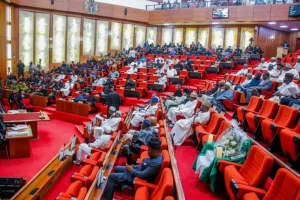 The Senate has assured Nigerians that legislation to establish state police will be enacted before the end of 2026, following approval of the constitutional amendment by the required two-thirds of state Houses of Assembly.
The assurance came on Monday as the Ondo State House of Assembly passed the Constitution of the Federal Republic of Nigeria, 1999 (Sixth Alteration) Bill, 2026, which seeks to establish state police services across the country.
The bill passed during plenary after scaling second and third readings, with all lawmakers present supporting its passage.
Ondo became the 25th state to approve the amendment, following earlier endorsements by Osun, Adamawa, Delta, Edo, Kwara, Nasarawa, Ogun, Oyo, Plateau, Rivers, Taraba, Zamfara, Enugu, Anambra, Imo, Ekiti, Kebbi, Akwa Ibom, Bayelsa, Benue, Cross River, Abia, Yobe and Kaduna states.
The Chairman of the Senate Committee on Media and Public Affairs, Yemi Adaramodu, told The PUNCH that the National Assembly was determined to complete the process before its Christmas recess.
He described the state police proposal as a priority in the ongoing constitutional review, adding that lawmakers would act swiftly once the relevant documents were received from the executive.
“Already, we have promised Nigerians that before the end of this 10th National Assembly, a new police law will be enacted for Nigerians. And then, before we even leave for Christmas, it would have been done,” Adaramodu said.
His comments came as the Presidential Working Group on the National Policing Bill submitted the draft National Policing Bill, 2026, alongside 29 consequential amendment bills, to the Ministry of Justice for legislative drafting review and validation.
The working group, chaired by the Chief of Staff to the President, Femi Gbajabiamila, expects the ministry to return the validated drafts by October 30. The group would then consider the documents before presenting them to President Bola Tinubu for approval and subsequent transmission to the National Assembly.
Gbajabiamila had earlier said the proposed bill was 90 per cent ready and would be transmitted to the National Assembly on October 29.
However, Adaramodu declined to comment on the executive’s timeline, saying the Senate would wait for formal communication.
“Well, we cannot pass comment on what the executive said until we receive correspondence from them,” he said.
The Senate spokesman also dismissed concerns about delays in securing state-level approval, explaining that the 30-day period was intended for state legislatures to submit their inputs.
He expressed confidence that the process would be completed before the end of the year, describing state policing as necessary to improve security enforcement and tackle killings, abductions, banditry and terrorism.
“There’s nothing to worry about. The policing bill will be done expeditiously as we promised and it will become law before the end of this year, by the grace of God. We are determined,” he said.
Adaramodu added that lawmakers would ensure relevant stakeholders had opportunities to contribute to the proposed framework because of its implications for communities nationwide.
Also speaking, the senator representing Anambra Central, Victor Umeh, said the approval by 24 state assemblies had met the constitutional threshold, adding that the resolutions would return to the National Assembly for verification.
Umeh said the National Assembly supported decentralised policing because of Nigeria’s size and the need to bring security operations closer to communities.
“We cannot continue to have one central police force to provide security to Kebbi, Calabar, Sabon Gari, Ikot Abasi and all the far ends of this country. No, we must decentralise it to have two police commands, especially state police, to get nearer to the grassroots,” he said.
He argued that state police would improve intelligence gathering and enable faster responses to threats, particularly because officers familiar with local communities could better understand security challenges.
“Every security issue is local. Through the intelligence of people in that state, we will be able to respond on time. Every criminal hides in the community, and there is a tendency they would be known to the locals,” Umeh added.
The proposed constitutional amendment seeks to alter Section 214 of the Constitution to replace the existing Nigeria Police Force with a Federal Police Service and State Police Services.
The Senate passed the Sixth Alteration Bill on June 24, followed by the House of Representatives. The National Assembly transmitted the proposal to the 36 state Houses of Assembly on September 16 for consideration.
Speaking before the bill’s passage in Ondo, the Assembly’s Majority Leader, Olatunji Oshati, moved the motion, which was seconded by Allen Oluwatoyin, representing Ese Odo constituency.
Oshati said lawmakers had considered the implications of the amendment and believed state police would help address the country’s security challenges.
The Speaker of the Assembly, Olamide Oladiji, described the proposed establishment of state police as long overdue, saying it would enable security agencies to respond more swiftly to crime and other threats.
“State policing would help reduce crime through improved intelligence gathering and proactive security measures,” Oladiji said.
He subsequently directed the Clerk of the House, Benjamin Jaiyeola, to transmit the approved document, alongside the assembly’s observations, to the National Assembly.