

2027: Peter Obi Rules Out Stepping Down for Atiku, Says Parties Must Decide on Alliance
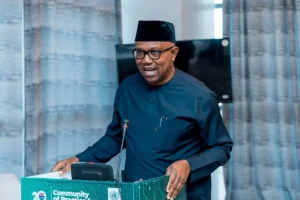 The presidential candidate of the Nigeria Democratic Congress, NDC, Peter Obi, has ruled out personally stepping down for his African Democratic Congress, ADC, counterpart, Atiku Abubakar, ahead of the 2027 presidential election.
Obi said any decision on a possible opposition alliance must now be taken by the political parties rather than individual candidates.
The former Anambra State governor stated this in an interview with Arise Television aired on Thursday, where he spoke on the 2027 election, the opposition coalition, the economy, national unity, security and governance.
Asked if he would step down for Atiku, Obi said both politicians were now presidential candidates of different parties, making the issue one that required negotiations between the parties.
“Do you know where we are now? Where we are now is that I’m a candidate, my leader Atiku is a candidate of another party, so you are talking about two parties coming together; it’s no longer me or me, as you are now talking about parties coming together.
“All those parties have candidates. So, it is a discussion. It is no longer me, as Peter, talking. It is like a situation where two corporations are trying to come together. It is no longer something where the two CEOs go for a drink and say, ‘We are going to work together’. They need to look at how to bring these two corporations together,” he said.
The comments come amid continuing efforts by opposition politicians to form a common platform capable of challenging President Bola Tinubu and the All Progressives Congress, APC, in 2027.
Obi and Atiku were part of an opposition coalition that adopted the ADC as its platform in 2025, but the two politicians eventually emerged as presidential candidates of different parties.
Obi subsequently became the presidential candidate of the NDC, while Atiku emerged as the ADC candidate.
Obi also denied rejecting an offer to become Atiku’s running mate, saying no such offer had been made to him.
“I don’t know where that was said. I wasn’t even in a position where that was being offered, and I refused,” he said.
Obi and Atiku previously ran on the same presidential ticket, with Obi serving as Atiku’s running mate under the Peoples Democratic Party, PDP, in the 2019 election.
On the economy, Obi identified the floating of the naira as one policy of the Tinubu administration he would retain if elected, although he said he would focus on increasing productivity to strengthen the currency.
“There’s one – the floating of the Naira. I’m not going to defend it. But I’m going to put productivity to make it more valuable to the people,” he said.
He said Nigeria needed to move from a consumption-driven economy towards greater production, agriculture, exports and investment.
Obi also warned against allowing ethnic considerations to dominate the 2027 election, urging Nigerians to assess candidates based on their programmes and capacity to govern.
“Our election should not be driven by tribalism,” he said.
He further expressed his commitment to the development of Northern Nigeria, arguing that the region has significant agricultural potential.
“I am committed to the future of the North. I believe the North has so much to offer Nigeria. As a country, we can make more money from agriculture than we do from oil,” he said.
Addressing historical grievances associated with the 1966 military coup, Obi said he was only four years old when the event occurred and urged Nigerians to focus on unity and the future.
“There were regrettable things that happened in our collective history. I was not personally involved in those sad events, but it is time to show love and pursue unity in Nigeria. We must not dwell on the past. We can only build through love,” he said.
The NDC candidate also criticised Nigerian presidents who spend their holidays abroad, saying the President should remain in the country and use such periods to engage directly with citizens and communities facing security and developmental challenges.
“Nigeria’s President must spend his vacation in Nigeria. We cannot continue with this nonsense. Where do other countries’ own leaders spend their vacations?
“Nigeria’s President should go to Zamfara, to Borno, to Anambra, to anywhere. As President of Nigeria, I will visit other countries, but I will not take my holidays there,” Obi said.
He argued that security concerns should not prevent the President from spending time in affected parts of the country.
“It doesn’t matter. Because that’s the country he lives in. That’s why he takes the money to Europe,” he said.
Obi also criticised brief presidential visits to crisis-hit states, saying the President should spend enough time on the ground to engage residents, traditional rulers, state officials and other stakeholders.
“He should go to Benue and say, ‘I’m here for the next three days; I want to see these stakeholders in the state,’” he stated.