

Obi, Benue Government Trade Blame Over Blocked Yelwata Visit
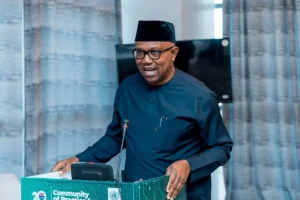 The presidential candidate of the Nigeria Democratic Congress, Peter Obi, and the Benue State Government on Tuesday traded blame over the disruption of his planned visit to Yelwata, as some youths barricaded a major road in Makurdi and prevented his convoy from proceeding to the community.
Obi, who said he travelled to Benue to condole with families of victims of the Yelwata massacre, accused suspected hired thugs, allegedly acting on the orders of a government aide, of blocking his movement.
But the state government denied involvement in the incident, insisting that Obi failed to follow the necessary protocol by formally notifying the government of his visit. It also accused him of attempting to create a political controversy.
The Yelwata attack occurred between June 13 and 14, 2025.
The conflicting claims came even as the Benue State Police Command confirmed that it was aware of Obi’s visit and had deployed officers to provide security for his movement.
The police, however, said it was investigating why some youths stopped the presidential candidate’s convoy.
The incident occurred on Gboko Road, near the Nigerian Air Force Base and Makurdi Airport, where protesters reportedly barricaded the road and chanted, “We don’t want Peter Obi.”
The development caused traffic disruption in the area for several hours and eventually forced Obi’s convoy to turn back to the airport before he returned to Jos, Plateau State.
Obi had arrived in the state as part of a planned visit to Yelwata, where more than 200 people were reportedly killed in an attack on the community in June 2025.
Speaking at the scene in a video posted by News Central Television on its X page, Obi said he was informed that youths had been mobilised to prevent him from proceeding to the community.
“I was told that youths, led by an SA (Special Assistant) to the government, have decided to block the road and make sure I don’t go there,” he said.
The former Anambra State governor described the development as unacceptable, arguing that the youths involved were themselves victims of poverty and insecurity and should not be deployed for political purposes.
“The rascality they are bringing into this country is totally unacceptable. People are being killed every day in Benue. People want to show that they are with them, and I came here all the way this morning, a long distance, only to be told what you are seeing here,” he said.
Obi maintained that his planned visit was humanitarian and that his itinerary had not been concealed from the relevant authorities.
The NDC presidential candidate was expected to travel to Yelwata to meet families of victims of the June 2025 attack, which drew widespread condemnation and renewed national attention to the worsening security situation in Benue.
However, his planned journey was cut short when the youths blocked his convoy around Gyado Villa along Gboko Road.
Despite the presence of police officers, the youths reportedly insisted that Obi would not be allowed to proceed.
The governorship candidate of the NDC in Benue State, Prof. Terhemba Shija, said the party had duly informed security agencies about Obi’s visit.
He said the visit was not intended as a campaign rally but to enable Obi to identify with families of victims of the Yelwata attack.
“Is Obi not a presidential candidate? INEC has lifted the ban on campaign and we duly informed the police and DSS about his visit to the state. They deployed police and DSS to be with us,” he said.
When asked if the state government was informed of the visit, Shija said the state government should be aware that the Independent National Electoral Commission had lifted the ban on campaigning.
“But the government is aware that INEC has lifted the ban on campaigning; do we need to take permission from the candidate?” Shija asked.
The governorship candidate described the incident as “a demonstration of fear, a clear show that Obi is the man to watch,” arguing that there was no justification for preventing the presidential candidate from visiting bereaved families.
“He has come just to see families of victims of Yelwata; why should somebody stop a legitimate candidate after he has officially given notice to CP and DSS?” he asked.
But the Benue State Government rejected allegations that it sponsored or organised the youths who blocked Obi’s convoy.
The Commissioner for Information and Orientation, Solomon Iorpev, said Obi had failed to officially inform the state government about his visit, arguing that, given his status as a former governor and presidential candidate, adequate security coordination was required.
According to Iorpev, the state government had a responsibility to ensure the safety of high-profile visitors but could not effectively discharge that responsibility if it was not formally informed of their movements.
He said, “A high-profile person who has been a former governor of a state is coming into the state; he should have written a letter to the state government.
“We are supposed to guarantee his safety and protection, but in an instance where no letter was written, we could not guarantee his safety. This is not the first time he is doing this. He is just looking for our trouble. We are peace-loving and hospitable people.”
The commissioner said he did not know the identity of the youths who blocked the road, but suggested that the incident might have coincided with a gathering of youths from the state’s 23 local government areas.
The Chief Press Secretary to Governor Hyacinth Alia, Kula Tersoo, also denied that the governor or the state government had anything to do with the incident.
In a statement issued on Tuesday, Tersoo described Obi’s allegations as unfounded and an attempt to drag the governor and the people of the state into what he characterised as an internal political dispute within the NDC.
“We wish to emphatically deny that the government of Rev. Fr. Hyacinth Alia has an idea of what Mr Obi is talking about.
“Based on his antecedents of making untrue statements against the state, we have every reason to doubt whether he visited Makurdi, the state capital, today,” he said.
Tersoo said Obi did not pose any threat to the governor and argued that if there had been any genuine security concern surrounding the presidential candidate, recognised security agencies would have been responsible for handling it.
He stated that the governor was opposed to thuggery and that his administration did not use political thugs as instruments of governance or security.
Tersoo said the state government was committed to the rule of law and relied on recognised security agencies to maintain peace.
“It is, therefore, curious that an individual presenting himself as a presidential candidate could arrive in a state without the relevant security authorities being formally informed of his movement.
“Ordinarily, such a visit would attract the attention and necessary security coordination involving the Commissioner of Police and other relevant security agencies.
“We really find it difficult to understand the basis for Mr Obi’s attempt to connect every fabrication with the Benue State Government, and Governor Hyacinth Alia in the first instance.
“If Mr Obi is confronted with disagreements or internal political challenges within his party structure in Benue State, those issues should be resolved within the party rather than being conveniently transferred to the State Government,” he said.
However, the police account appeared to contradict a key aspect of the state government’s claim that relevant authorities were not informed of Obi’s movement.
The Commissioner of Police, Cletus Nwadiogbu, confirmed that the police command had been notified of the visit.
The CP said he had directed the Assistant Commissioner of Police, Operations, to personally lead officers assigned to provide security for Obi.
“I also asked the AC Operations to personally lead the men, but unfortunately, on his arrival, we heard that the youth blocked the road because they didn’t want to see him. That is the reason we are going in to find out why such conduct, why the youth behave that way.
“We have tactically managed the situation for now, but we are not letting it go. We must get to the bottom of it to know why the youths said somebody cannot move.”
Nwadiogbu described Obi as “a very responsible man” and confirmed that the presidential candidate eventually returned after the blockade.
The police command’s spokesperson, DSP Peter Aondongu, had earlier confirmed that officers were deployed for Obi’s movement to Yelwata.
He said the reason the youths blocked the convoy remained unknown and that the command was investigating the circumstances surrounding the incident.
“We can confirm that the police are aware of the incident involving Peter Obi’s movement to Yelwata. Police operatives provided security for the movement.
“The reason the convoy was blocked by some youths is still unknown. We are monitoring the situation and investigating the circumstances surrounding the incident.
“Further updates will be provided accordingly,” the PPRO said.
Speaking in Jos, Plateau State, after departing Benue State, Obi expressed concern over the prolonged killings and mass displacement of residents in Plateau State, describing the continued existence of internally displaced persons camps as evidence of the state’s failure to guarantee citizens’ safety.
Speaking during a sympathy visit to a community in Mangu Local Government Area of the state, which was recently affected by attacks, Obi said his visit was not politically motivated but was aimed at identifying with Nigerians who had been forced from their ancestral homes by insecurity.
“As long as you are in an IDP camp, Nigeria is in an IDP camp. It is when you go home that Nigeria is at home. You are not supposed to be here,” Obi told displaced persons at the camp.
He called on the Federal Government to take decisive steps to end the killings, kidnappings and displacement of communities, particularly in Plateau and Benue states.
While acknowledging the role of prayers in addressing the nation’s challenges, Obi stressed that government had the primary responsibility of protecting lives and prosecuting perpetrators of violence.
“I hear people say we need prayers. Yes, we need prayers. But government must act. The people coming to kill are not from the moon. We know them. The Nigerian government should be able to deal with it,” he said.
Obi expressed worry over the humanitarian impact of the crisis, noting that about 45,000 persons from more than 20 communities in Plateau had been displaced.
“You can imagine 45,000 people displaced from over 20 communities. That is unacceptable. It is something we must not allow to continue,” he added.
The NDC candidate also decried the effect of the attacks on education, saying the destruction of communities had forced many children out of school.
He noted that this was his third visit to affected communities in the state, during which interventions such as the construction of a school and provision of water had been carried out.
“I came here today not to campaign. I came to assure you that you are in our thoughts. We are hoping that one day we will come here and none of you will be here because you have all returned to your homes,” Obi said.
The Peoples Democratic Party governorship candidate in Benue State, Chief Michael Aondoakaa (SAN), condemned the incident, describing it as an assault on democracy and the constitutional rights of Nigerians.
In a statement issued by his Media Assistant, James Ian, Aondoakaa argued that citizens had the constitutional right to move freely, associate and participate in political activities.
“As such, no individual, group, or government has the authority to deny any Nigerian access to any part of the country on account of political affiliation,” he said.
Aondoakaa said political leaders and presidential candidates should be allowed to travel across the country and engage with citizens ahead of the 2027 elections.
He said, “Any attempt to obstruct, intimidate, or attack a political leader exercising that right runs contrary to the spirit of democratic competition and undermines the President’s call for a peaceful and inclusive political process.”
Aondoakaa also argued that the incident violated the recently signed political peace accord under which political parties and candidates committed themselves to issue-based campaigns, non-violence and respect for the rights of political opponents.
The PDP candidate called for an impartial investigation and prosecution of anyone found responsible for obstructing Obi’s movement.
The NDC, for its part, demanded an immediate investigation into the incident and the arrest and prosecution of those responsible.
The party’s National Publicity Secretary, Osa Director, described the blockade as disturbing and condemnable, insisting that Obi’s visit was motivated by a desire to identify with victims of the Yelwata massacre.
“Although access to the community was denied today, the hearts and prayers of the NDC and our presidential candidate remain with the victims, their families, and the entire Yelwata community.
“We will not be deterred. The NDC will persist until we restore the fundamental responsibility of government: the protection of every Nigerian’s life,” the party said.
It subsequently called on the state government and security agencies to investigate the incident.
“We call on the Benue State Government and relevant security agencies to immediately investigate this incident, bring the perpetrators to justice, and guarantee the safety of all citizens and leaders who seek to show solidarity in times of grief,” Director added.
Former governor of Sokoto State, Aminu Tambuwal, also condemned the incident, describing the obstruction of Obi’s movement as unacceptable and undemocratic.
In a post on X, Tambuwal said Obi, as a Nigerian citizen, former governor and presidential candidate of a recognised political party, had the constitutional right to move freely across the country and undertake lawful activities.
He called on the Inspector-General of Police and other relevant authorities to investigate the incident and ensure that those responsible were held accountable.
The National Electoral Accountability Consortium and Tap Initiative for Citizens’ Development also called for an investigation into the obstruction of Obi’s convoy.
In a statement issued on Tuesday, the groups said videos and reports from the scene showed individuals blocking the road and moving towards vehicles in Obi’s convoy.
They, however, said the identities and motives of those responsible had yet to be established and urged an independent investigation.
The organisations warned political parties, candidates and their supporters against inflammatory rhetoric, threats and the mobilisation of supporters against political opponents as the country approaches another electoral cycle.
They called on the Nigeria Police Force and other security agencies to conduct a “prompt, impartial and transparent investigation” and prosecute anyone found culpable in accordance with the law.
The controversy is not the first between Obi and the Benue State Government over his proposed visits to the state.
In April 2025, Obi alleged that he was prevented from visiting Benue on humanitarian grounds.
The renewed dispute comes at a time when political parties are increasingly stepping up activities ahead of the 2027 general election.
The Independent National Electoral Commission has lifted restrictions on political activities, paving the way for parties and candidates to intensify mobilisation, consultations and public engagements.