

LOCAL GOVERNMENT AUTONOMY AND THE RULE OF LAW: WHY STATES MUST COMPLY, NOT CONFRONT
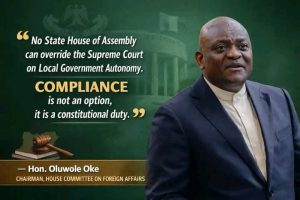
By Hon. Oluwole Oke, Chairman, House Committee on Foreign Affairs
Nigeria’s constitutional democracy is anchored on one non-negotiable principle: the supremacy of the Constitution and the finality of judicial interpretation. Nowhere is this principle more tested than in the ongoing national conversation on Local Government autonomy.
Recent pronouncements of the Supreme Court on Local Government administration and financial autonomy have reignited debates across the federation. While opinions may differ on policy preferences, the law is clear: once the Supreme Court has interpreted the Constitution, all arms and levels of government are bound to comply.
SUPREME COURT DECISIONS ARE NOT SUGGESTIONS
Under Section 235 of the 1999 Constitution, the Supreme Court is the final court of the land. Its decisions are not advisory, optional, or subject to legislative veto. They represent the authoritative meaning of the Constitution itself.
Consequently, no State House of Assembly—Osun State included—has the constitutional competence to enact laws that override, dilute, suspend, or circumvent Supreme Court decisions on Local Government autonomy. Any such law would be unconstitutional, null, and void.
This is not about politics. It is about constitutional order.
THE LIMITS OF LEGISLATIVE POWER
It is important to draw a careful distinction between legislative reform and judicial override. Legislatures make laws; courts interpret them. Once interpretation has occurred at the Supreme Court level, the legislature cannot revisit the same dispute through statutory maneuvers.
Even the National Assembly cannot, by ordinary legislation, reverse a Supreme Court judgment. The only lawful pathway for change—where policy reconsideration is genuinely required—is through constitutional amendment, undertaken transparently and applied prospectively, not retroactively.
WHAT STATES CAN STILL DO—LAWFULLY
Compliance with Supreme Court rulings does not render State Governments powerless. Far from it. States retain wide latitude to legislate in ways that strengthen Local Government democracy without undermining autonomy.
States may enact laws that:
• Guarantee regular, credible Local Government elections
• Promote transparency and independent audits
• Enhance administrative coordination without financial control
• Support capacity building and service delivery at the grassroots
What states cannot do is reintroduce control through renamed joint accounts, caretaker committees, or executive gatekeeping disguised as oversight.
COOPERATION, NOT CONFRONTATION
The path forward lies in inter-governmental cooperation, not constitutional confrontation. States and Local Governments can work together through memoranda of understanding, joint planning frameworks, and technical support mechanisms that respect the independence of elected councils.
This approach preserves harmony, reduces litigation, and strengthens service delivery.
THE CASE FOR CONSTITUTIONAL ADVOCACY
Where legitimate ambiguities exist—particularly around fiscal federalism and revenue allocation—the proper response is national constitutional dialogue, not unilateral state action.
The National Assembly, working with State Houses of Assembly, may initiate constitutional amendments to clarify grey areas. Until such amendments are lawfully enacted, the Supreme Court’s interpretation remains binding.
DEMOCRACY IS STRENGTHENED BY OBEDIENCE TO LAW
Local Government autonomy is not an assault on state authority; it is a constitutional design meant to deepen democracy and bring governance closer to the people.
Our democracy is strongest when political actors submit to the rule of law—even when rulings are inconvenient.
In the end, compliance is not weakness. It is fidelity to constitutional governance, respect for institutions, and commitment to Nigeria’s democratic future.