

Kaduna Adopts Dialogue Strategy as Uba Sani Inaugurates Peace, Security Committee
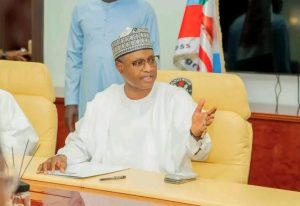 Governor Uba Sani of Kaduna State has inaugurated a Disarmament, Demobilisation and Reintegration (DDR), Peace and Security Committee as part of efforts to deepen non-kinetic measures in tackling insecurity across the state.
Speaking at the inauguration, the governor recalled that Kaduna had, until recently, grappled with widespread insecurity, as bandits and kidnappers operated freely across major routes and rural communities, crippling economic activities.
According to him, key corridors such as the Kaduna–Abuja highway and the Birnin Gwari axis had become notorious flashpoints, creating fear among residents and travelers.
Sani, however, noted that his administration adopted a proactive approach anchored on both kinetic and non-kinetic strategies to address the situation.
“Insecurity is a complex challenge that requires a comprehensive response. Beyond military operations, we must address the underlying issues such as poverty, social exclusion, and lack of education,” he said.
He explained that the state’s approach, now referred to as the “Kaduna peace model,” integrates security operations with dialogue, community engagement, and human development initiatives.
The governor added that through collaboration with security agencies and the Office of the National Security Adviser, operational capacity had been strengthened, leading to improved safety along previously dangerous routes and a revival of economic activities.
Emphasising the importance of dialogue, Sani said the government engaged community leaders, traditional institutions, and repentant actors to rebuild trust and promote lasting peace.
“Force alone cannot deliver sustainable peace. Dialogue is not a weakness but a strategic tool for stability,” he stated.
Also speaking, Abimbola Wonosikou, Director of Preventing and Countering Violent Extremism at the National Counter Terrorism Centre (NCTC), described the inauguration as a significant step towards achieving sustainable peace in Kaduna and Nigeria at large.
She disclosed that nationwide consultations had highlighted the need for state-level DDR structures to complement a national framework currently awaiting approval.
Wonosikou noted that the initiative would focus on disarmament, dismantling violent groups, and reintegrating affected individuals into society.
Similarly, Paul Nyulaku, Technical Adviser on the National DDR Framework, commended the Kaduna State Government, describing its reconciliation efforts as widely acknowledged across the country.
He added that Kaduna is the first state to establish such a committee, which is built on a comprehensive framework covering key areas including political dialogue and negotiation.
The committee, facilitated by the Office of the National Security Adviser and the NCTC, is expected to serve as a coordinating body for peacebuilding and security interventions in the state.